


Kindness is a word we love. Education is a word we debate. Dignity is a word we quote often in captions, sometimes in speeches, and rarely in budgets.
But every once in a while, someone shows up who doesn’t just talk about these words, but embodies them.
In the very first episode of Mapabear Impact, Siddhesh Lokare talks to Mapabear about a journey that flows effortlessly from the personal to the structural: childhood and powerlessness, hope and hard facts, content and consequences. But running through it all is one idea that has defined his work: Impact is measured kindness.
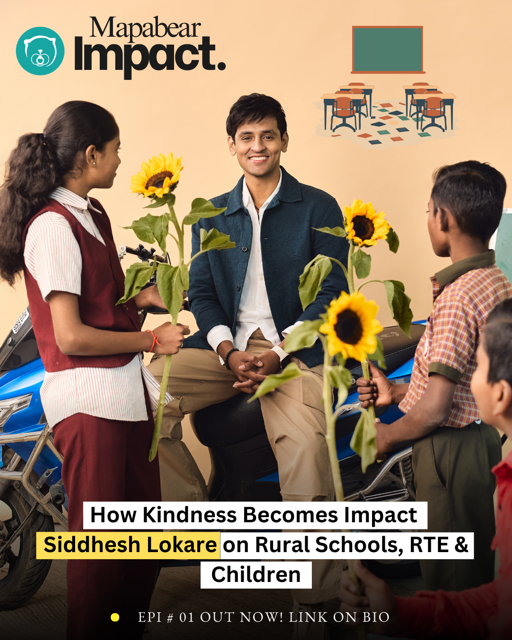
This episode also launches a new editorial direction for Mapabear Impact, one that explores parenting, childhood, and society not just through personal choices, but through the systems that shape those choices long before families ever get to the “conscious parenting” lexicon.
Because in Siddhesh’s world, the story starts much earlier. It starts at the grassroots.
Table of contents [Show]
- “One person is enough” is reassuring. “One person is not enough” is true.
- Reparenting the self, refusing the mask
- From wanting fame to finding purpose
- When Classrooms Replace Campaigns
- Children Who Risk Their Lives to Learn
- The Right to Education: A Promise vs Reality
- Teachers: The Quiet Backbone of the System
- When Parents Disappear, Society Pays
- Education Beyond Textbooks: Periods, Dignity, and Dialogue
- Measuring Kindness, Not Performing It
- Saku, Sunflowers, and the Power of Symbols
- What Comes Next
- The Beginning of Something Deeper
“One person is enough” is reassuring. “One person is not enough” is true.
Mapabear begins by capturing what many people feel when they encounter Siddhesh’s work: the awe of seeing one person seem to do so much. But Siddhesh is quick to challenge the hero narrative.
Where he is today, he insists, isn’t proof that one individual can do it all. It’s proof that when a group of people(his team) chooses purpose over comfort, something real begins to take shape.
He calls it a hive mind, a shared mindset that spreads from a small core team outward, transforming even casual conversations into something meaningful, simply because people sense that someone is truly listening.
It’s a subtle, but essential, shift in how impact works.
"Kindness is not an act of God," he says. “It's an act of being human”
Siddhesh embraces the affection people show him, many call him Dev Manus, or god-sent, but he draws the line at worship. Praise, he says, should live in the heart, not the head.

He believes many of these compliments stem from a quiet regret: “I could have done this too… but I didn’t.” His advice is simple: stop dwelling on the life you didn’t live, and start practicing kindness, however small. Teach someone a skill. Lift up one person around you.
That’s how impact becomes shared, not performative.
Reparenting the self, refusing the mask
Siddhesh speaks with striking honesty about his childhood and how grateful he is that his parents never pretended things were okay when they weren’t.
Faking comfort, he says, only creates delusion. And delusion pulls you away from reality.
So, in a society obsessed with looking happy, he does something different: he refuses to wear the mask.
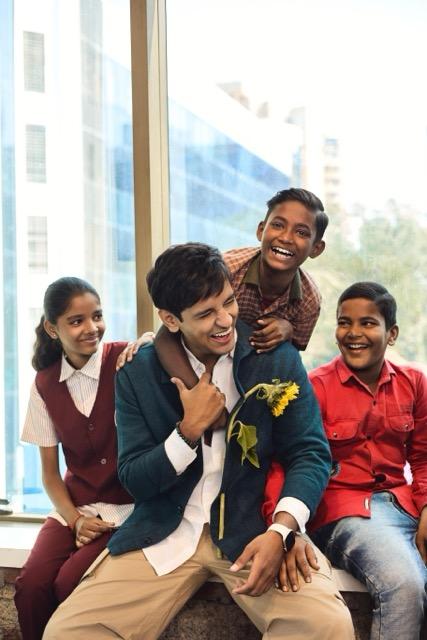
Helping others, he explains, isn’t about sainthood. It’s also a way of healing yourself. A way to reparent the hurt child within.
He calls it “positive selfishness” the kind that lets you show up for others, without needing applause in return.
From wanting fame to finding purpose
Siddhesh is refreshingly honest about where it all began.
“I wanted fame. I wanted validation. I wanted to be seen,” he admits. “I didn’t even understand what being a hero really meant.”
In the early days, content creation was all about visibility, being in front of the camera, getting noticed, being valued by others at a time when he struggled to value himself.
But everything changed when he turned his focus outward, toward people whose stories were never meant to trend.
“I realised a hero isn’t someone who knows they’re a hero,” he says. “A hero is someone who’s just doing what needs to be done.”
That insight marked a shift from simply documenting and listening to stepping up and taking action.
When Classrooms Replace Campaigns
While travelling through villages and rural communities, Siddhesh found himself walking into “classrooms” that barely resembled schools.
He recalls one of the earliest days of Mission 30303, it was his day 2 of this mission when he trekked nearly two kilometres to reach a school in Dargawadi, Maharashtra.
“The walls of the school everything looked like the burst set of Om Shanti On movie, the floor was slippery with fungus. It wasn’t safe to walk,” he remembers. “The teachers told me children weren’t even allowed to touch the walls because they were that dangerous.”
That moment changed everything.
“I realised I couldn’t fake this mission anymore,” he says. “I didn’t need to dramatize anything. Reality was already harsh enough.”
Children Who Risk Their Lives to Learn
As he moved across Maharashtra, Siddhesh uncovered story after story that showed the hidden cost of education.
Children crossing 40-foot-deep backwaters on flimsy Thermocol boats just to reach school. Others walking barefoot for kilometres in brutal heat choosing discomfort, even danger, because learning mattered more.
These children weren’t attending school because the system made it easy. They came because they believed in their teachers.
“These kids could die, and no one would even know,” Siddhesh says, without softening the truth. “That’s how fragile access to education still is.”
And yet, in these same harsh conditions, he heard dreams spoken without irony of becoming teachers, pilots, doctors, IPS officers. Dreams that made him rethink what success even means.
“Success isn’t something you touch,” he reflects. “It’s something you feel. For me, success will be seeing these kids years later - educated, independent, employed, and living with dignity.”
The Right to Education: A Promise vs Reality
India’s Right to Education (RTE), outlined in Article 21A of the Constitution, promises free and compulsory education for children between six and fourteen. On paper, it’s a powerful law.

“The irony,” Siddhesh points out, “is that the Right to Education isn’t a promise, it’s already written into law.”
But what he saw on the ground was a very different story.
“Most of these kids don’t even know RTE exists,” he says. “It’s in the law, but completely invisible in their lives.”
He highlights the troubling gap between policy and practice - schools that aren’t supposed to charge fees but still do it indirectly, and others that offer free education despite financial strain. He also draws attention to Article 47, which mandates better nutrition and public health, and schemes like PM POSHAN, meant to feed children through government schools.
“For many kids, education isn’t the first priority - survival is,” Siddhesh explains. “If food isn’t guaranteed, learning doesn’t even make the list.”
This is the intersection where his work meets parenting, psychology, and public policy.
“It’s easy to talk about child psychology,” he says, “but how can you really understand a child without first understanding the ground realities like hunger, fear, and neglect?”
Teachers: The Quiet Backbone of the System
If children are the heart of Siddhesh’s work, then teachers are its backbone.
“Every great school we visited had an extraordinary teacher at the helm,” he says. “Their values set the standard for the children.”
He talks about schools that run all year round - 365 days, teachers who have devoted their entire lives to education, and classrooms where students tackle math problems more complex than those seen in many city schools.
“Never underestimate the power of teachers in India,” Siddhesh says firmly. “They’re the ones holding the system together.”
When Parents Disappear, Society Pays
Some of the hardest truths Siddhesh shares don’t come from remote villages but from urban slums.
He recalls meeting children whose parents had completely checked out - lost to addiction, poverty, or trauma. In one heartbreaking moment, he met a father so deep in substance abuse that he no longer remembered his child’s real name.
“When parents give up on parenting altogether,” Siddhesh warns, “society pays the price. These kids aren’t born dangerous, they’re made invisible.”
It’s a harsh truth. But one he’s seen firsthand.
“These are the children who grow up without direction, without care, without dignity,” he says. “And then we act surprised when society begins to crumble.”
Education Beyond Textbooks: Periods, Dignity, and Dialogue
Siddhesh’s work goes far beyond textbooks and classrooms.

In Nithari, a place burned into India’s memory for tragedy and neglect he and his team began hosting something revolutionary: “First Period Parties” for young girls.
These weren’t just sessions on menstrual health, they were full-blown celebrations that blended sex education, awareness, and joy. For many of these girls, it was the first time anyone had treated their period as anything other than shameful.
“We decorated the halls with pads, cups and everything,” Siddhesh shares. “We invited educators, had open conversations, even cut cake. We made normal what had always been a taboo.”
For him, this isn’t “extra.” This is education - not optional, not secondary, but foundational.
Measuring Kindness, Not Performing It
What sets Siddhesh’s work apart is his unwavering belief that kindness should create real, measurable change.
“Kindness equals impact,” he says. “And impact has to be measured.”
His most ambitious project so far, Mission 30303, involved visiting 30 remote schools in 30 days and raising ₹3 crore to rebuild infrastructure, support teachers, and bring dignity back into learning spaces.
The contributions came from everywhere: children donating their piggy banks, couples redirecting wedding funds, families naming their babies after him or the mission itself, teachers collecting small amounts from students, and brands and philanthropists stepping up quietly.
“The very people we empowered turned around and gave back,” Siddhesh says. “That’s when I knew this isn’t about charity. It’s about community. It’s about taking responsibility for each other.”
Saku, Sunflowers, and the Power of Symbols
Every journey needs its symbols. For Siddhesh, there are two(apart from his super talented team who worked like warriors): Saku, his trusty scooter that carried him over 5,000 kilometres, and the sunflower.
“Saku never stopped,” he says with a smile. “Not even on the worst roads.”

The sunflower, to him, stands for consistency, resilience, and always turning toward the light even in the harshest conditions.
“It carried the energy of the mission,” he says simply.
What Comes Next
Siddhesh isn’t slowing down. If anything, he’s thinking even bigger.
He talks about scaling the impact not just to ₹30 crore, but maybe even ₹300 crore. About building innovation-driven schools inspired by India’s ancient Gurukul traditions. About doing whatever it takes to make sure no child is ever denied an education.
“The goal is to build a framework where people start empowering each other,” he says. “I want to create systems that work so well… that people don’t need me anymore.”
The Beginning of Something Deeper
This is why Mapabear Impact begins here.
Because Siddhesh Lokare’s journey reminds us that real impact doesn’t arrive with noise or fanfare: it’s built quietly, choice by choice. It’s in the pause to listen more deeply. The willingness to stay a little longer. The decision to act, even when no one’s watching.
For parents, educators, and everyday citizens, this isn’t a conclusion: it’s an invitation.
To notice what’s been ignored.
To care a little more than before.
And to remember that kindness, when practiced with purpose, can reshape the future: slowly, powerfully, and for good.
⸻
Watch here - Mapabear Impact | Episode 1

 Guiding and Empowering Parents with fact-checked excellence -